
Live Music Photography Tips for Better Concert Photos
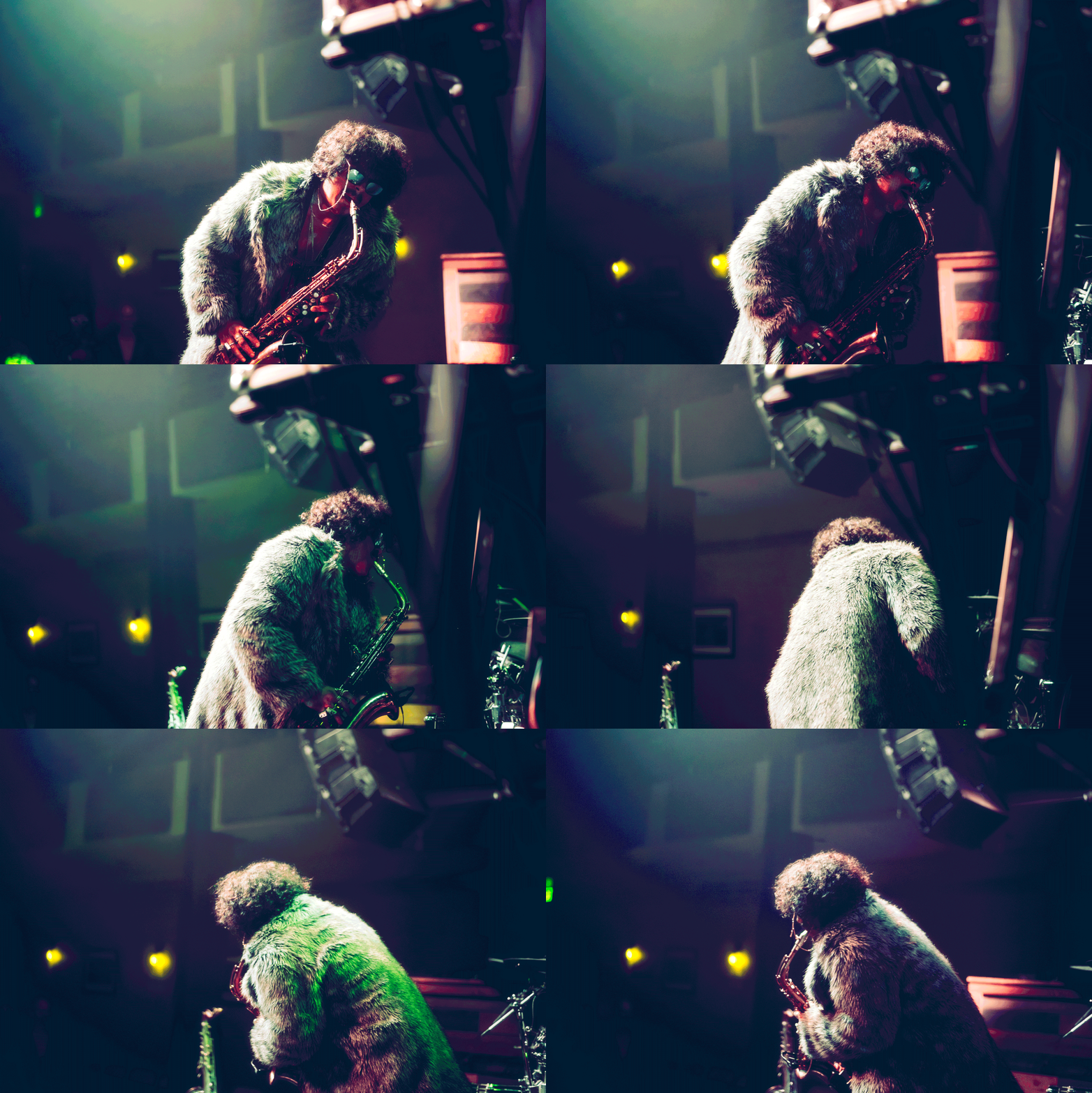
Pictured: Ty Piña performing saxophone with Boogie Lights at 10 Mile Music Hall. Frisco, CO. Jessica Dnea Imagery
GIF made with Adobe Photoshop
Concert photography is not regular photography with louder music. The biggest difference is the light.
Concerts are dark. The lighting changes constantly. The colors are often intense: blue, red, purple, green, strobes, lasers, backlight, light mapping, and fast-moving patterns. That light is not just something you work around. It is what creates the mood, shape, detail, energy, and emotion of the image.
No light means no picture. So if someone asks for a crowd photo in the middle of a dark room, you either need flash or you need to wait for usable light. The same is true on stage. You are not just photographing a person. You are photographing the moment when the artist, the light, the movement, and the music all line up.
When the lights create a design, pay attention. If there are lasers, beams, repeating shapes, or projected patterns, wait for the strongest version of that design. Symmetry can be especially powerful. Do not rush through the moment just because something is happening. Watch the light. Watch the artist. Wait for the frame that actually says something.
Good concert photography helps the band. It gives them proof of the energy in the room. It gives them images they can use for promotion, announcements, websites, press kits, social media, and future bookings. The photos should make people understand why the show mattered.
How do you handle low light at live shows?
A wide-aperture lens is your best friend. If you are shooting concerts with a lens that does not open to f/2.8 or wider, you are going to run into low-light problems all night.
A good starting range for live music is usually:
Aperture: f/1.2–f/2.8
ISO: 400–3200, sometimes 6400 depending on the lights
Shutter speed: 1/125–1/400 depending on movement and style
If you want to freeze motion, aim closer to 1/250–1/400. If your lens does not open wide enough, then something else has to move. You may need to raise your ISO, lower your shutter speed, or make a creative choice with motion blur.
There is room to experiment. For example, if you shoot at f/8 while a spinning light or beam is pointed toward your subject or toward you, the light can naturally starburst. That can be really beautiful. But the higher your aperture, the less light comes into the sensor, so you may need to raise your ISO to balance it.
You do need to check your images as you go. Look at a few photos and make sure your subject is exposed properly. Then adjust and keep shooting. Concert lighting changes constantly. The intensity changes. Your distance from the subject changes. Your angle changes. This is not set-it-and-forget-it photography. You have to keep paying attention.
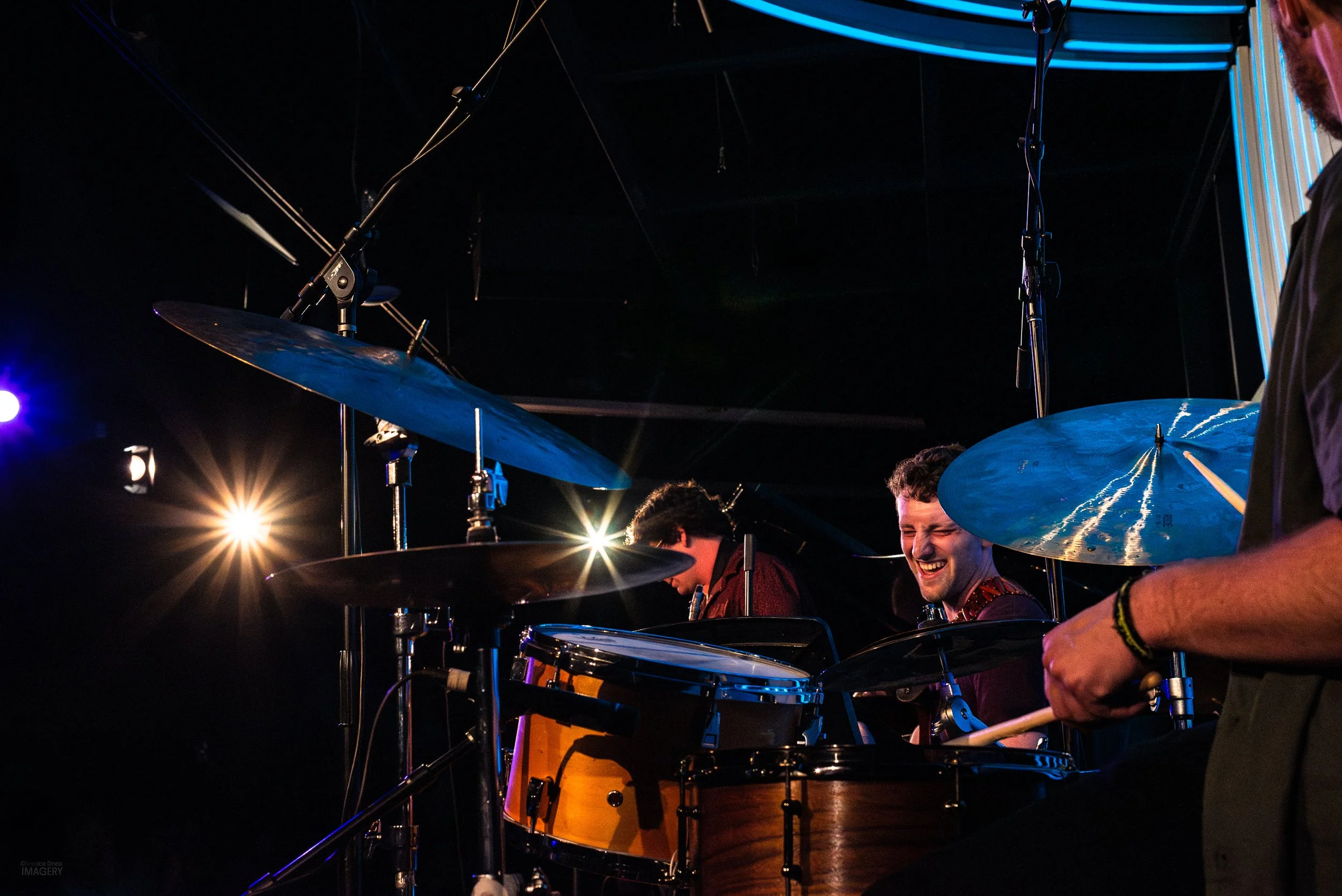
Pictured: Jordan Lovinger on bass at Dazzle. Denver, CO. Jessica Dnea Imagery
Starburst Camera Settings: 1/125 sec at f / 8.0, ISO 3200
What camera settings work best for concert photography?
For clean, in-focus concert photos, a strong base is:
f/1.2–f/2.8, ISO 400–3200, shutter speed 1/250–1/400.
That is a starting point, not a rule. If the lights are strong, drop your ISO. The lower your ISO, the cleaner the image. Most photographers are not raising ISO because they want to. They are raising it because the room is dark and the image needs enough light to exist.
If you want sharp performance images, that base range will usually help. If you want something more experimental, move from there. Drag the shutter. Catch motion. Let the lights stretch. Let the movement tell part of the story. Just know what you are choosing and why.
Why does timing matter so much during a concert?
Timing matters because the light is the photo.
You need to wait for your subject to be illuminated the way you want. Watch the performer. Watch the lighting. Feel the rhythm. Think about how the moment is going to translate in camera before you press the shutter.
Concerts also have key moments. A band may hit a drop, a solo, a crowd interaction, a shoutout, a jump, a dramatic pause, or a final pose. Sometimes those moments are planned. Sometimes they happen once and disappear.
As a concert photographer, you have to be ready for the moments that help the artist. They may need a family-style shot of the band and crowd at the end of the show. They may need a clean hero image. They may need the shot that shows the room was packed, the crowd was engaged, and the performance had energy.
You might not know ahead of time. The artist might not know ahead of time. That is why you need to be ready with the right lens, the right settings, and the right position. If the moment happens, you cannot be stuck at the back of the room fumbling with your camera while everyone is waiting.
That is the job. Be ready.
How do you capture the energy of the artist, crowd, and venue?
You have to care about the music.
If you feel the music, you can anticipate the movement. You can feel when the drop is coming. You can tell when the crowd is about to react. You can sense when the artist is building toward something.
Get in the pit. Get to the front row. Watch the artist closely. Learn their habits. Does the singer drop to the ground? Does the guitarist jump during a certain song? Does the DJ lean into the drop? Does the band gather together at the end? Does someone always have a big crowd moment?
Be ready for that.
Your job is not just to show that someone stood on a stage. Your job is to show what the performance felt like. The light, sweat, movement, crowd, color, expression, and tension all matter. These images help the band communicate who they are to people who were not in the room.
That is why concert photography matters. It is technical, but it is also responsive. You are listening, watching, adjusting, and choosing the moments that help the artist tell the story of the show.
What camera is best for live concerts?
You do not need the newest camera body to shoot live concerts well. I use an old DSLR and a newer mirrorless camera, and you can absolutely get the job done with basic gear if you understand light, timing, and your settings.
If you are just getting started, I think one of the smartest moves is to buy an older camera body and put more of your money into a good lens. The lens matters a lot in concert photography because the rooms are dark and the light changes constantly.
You probably do not need the kit zoom lens that comes with a lot of beginner cameras, especially if it is something like an f/3.5–5.6 zoom. In low light, that lens can become frustrating fast. You may barely use it once you understand what a faster lens can do.
A 50mm prime lens is a killer place to start. People call it a nifty fifty, thrifty fifty, whatever. It does not zoom, so you have to move your body to frame the shot. That is not a bad thing. Concerts are energetic, and your photos usually get better when you match that energy instead of standing still in one spot all night.
A 50mm prime is also budget-friendly. Depending on your camera brand, you can usually find one around $100–$150, especially used. I use a 50mm f/1.8, and that kind of lens is great for low light because it lets in more light than a basic kit lens.
The lower the f-stop number, the wider the aperture opens. A wider aperture lets more light hit the sensor, which is exactly what you need in dark venues. That is why lenses like f/1.8, f/2, or f/2.8 are so useful for concerts. They are also beautiful for portraits because they can create that soft background separation.
And no, you are not stuck shooting wide open forever. A 50mm f/1.8 can usually stop down to something like f/16, so you still have flexibility when you have more light or want more of the scene in focus.
If possible, I’d look for a camera body with a full-frame sensor, but do not let that stop you from starting. The bigger priority is learning how to work with the gear you have. Pair an older body with a good fast lens and a reliable memory card. I use cards like SanDisk Extreme Pro 200MB/s Class 10 V30 because concerts move fast and I do not want my card slowing me down.
If you can learn to shoot concerts on basic gear, especially in tough light, upgrading later will feel easy. Once you pick up a newer mirrorless camera, it can feel almost like shooting in auto because you already understand what the camera is trying to do.
Check out Fro Know Photo on Youtube for really in-depth camera comparisons in your niche. I’m not endorsed or associated with Jared Polin in any way but I have learned a lot from him and maybe you can too.
Also check out mpb.comfor used gear. Again, I am not associated with mpb.com in any way but I have bought a lot of used gear from them and support photographers on a budget.